How to report a repair so it gets fixed faster
What to put in a repair request, what counts as an emergency, and what Minnesota law lets you do if a repair never happens.
· 4 min read

Say the bathroom fan quits on a Sunday. You text your landlord "fan's broken," and a week later nobody has come. Was the message ignored, or did it just not give them enough to act on?
Most slow repairs aren't about a landlord who doesn't care. A vague request means a phone call to ask what's wrong, a second call to find a time, and a plumber who shows up without the right part. A clear request skips all of that.
What to put in a repair request
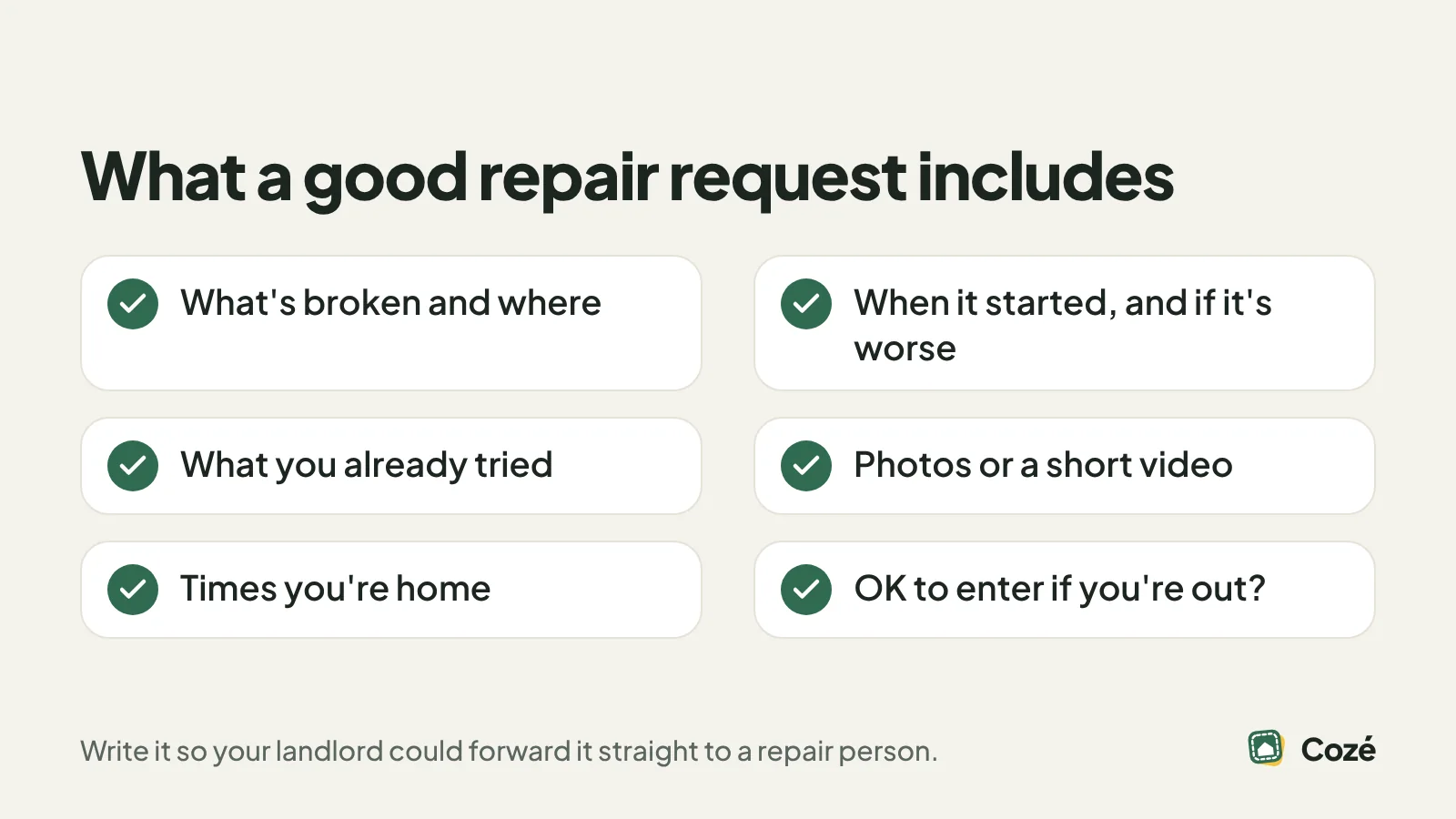
Write it so the landlord could forward it straight to a repair person without calling you first.
- What's broken and where. "Bathroom exhaust fan, upstairs" beats "fan."
- When it started and whether it's getting worse.
- What you've already tried, if anything. "Flipped the breaker, still nothing" saves a step.
- Photos, or a 10-second video if it makes a noise or leaks.
- Times you're home over the next few days.
- Whether they can come in if you're not there.
Photos do more than any paragraph. A picture of the water under the sink tells a plumber whether it's a loose fitting or a cracked pipe, and whether to bring parts. If the problem comes and goes, film it while it's happening.
Emergencies get a different kind of message
If you smell gas or a carbon monoxide alarm goes off, leave first and call 911 from outside. Then tell your landlord.
For other urgent problems, don't wait for business hours and don't bury it in a long text. Call, or mark it clearly as an emergency, and say what's happening right now. "Water is coming through the kitchen ceiling" gets a faster answer than "there's a leak."
Minnesota's emergency tenant remedies law gives a sense of what the state treats as an emergency when the landlord is responsible for the service. Its list includes losing heat, running water, hot water, or electricity, a serious infestation, and conditions that seriously threaten health or safety (Minn. Stat. 504B.381). Landlords who supply heat also have to keep living spaces at 68°F or warmer from October 1 through April 30 (Minn. Stat. 504B.161).
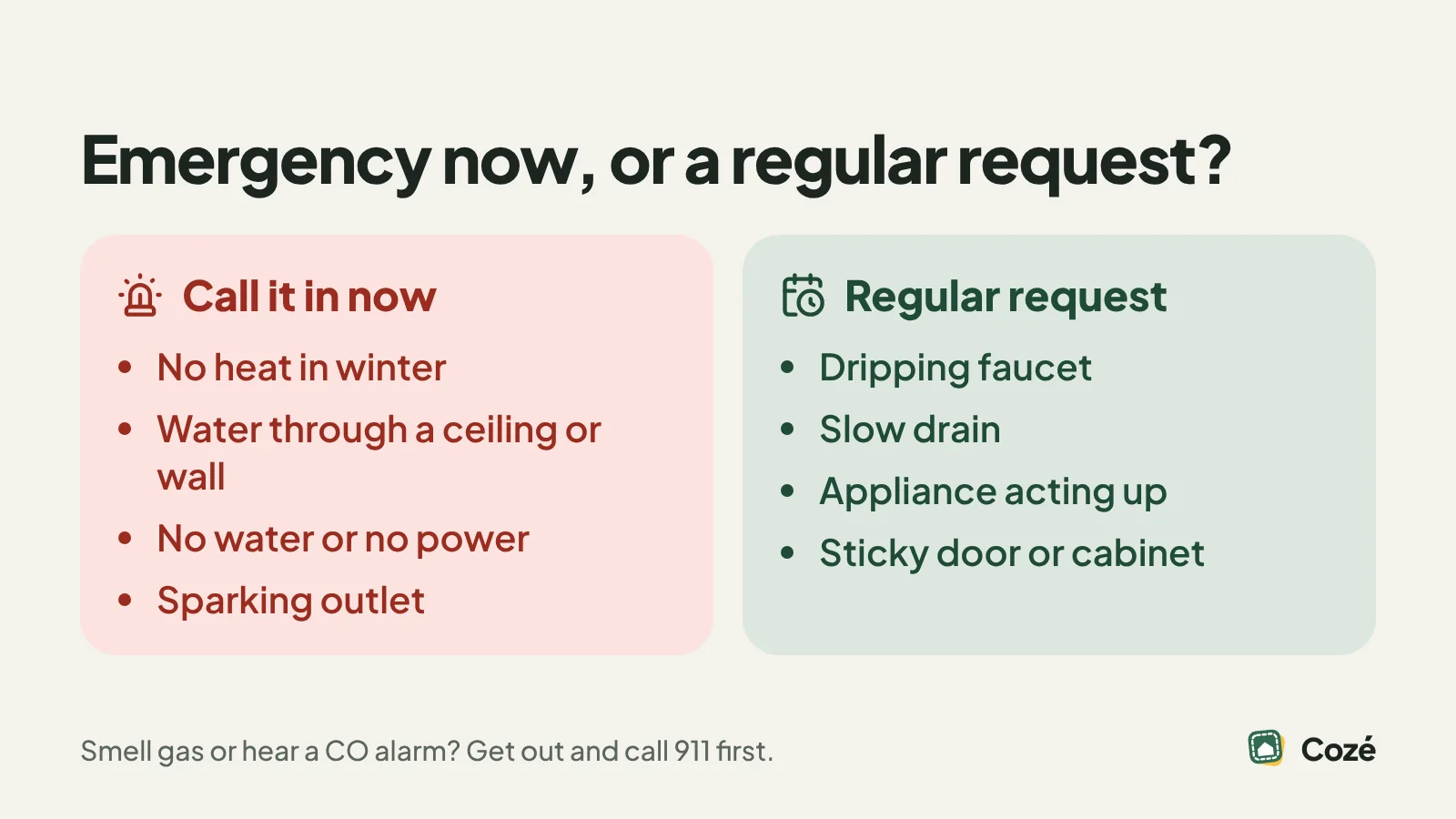
A dripping faucet, a slow drain, or a cabinet door that won't close can wait for a normal request. Send it anyway. Small leaks turn into big ones, and a written request is your record that you told them.
Make it easy to get in
In Minnesota, a landlord who wants to come in for repairs has to make a good-faith effort to give at least 24 hours' notice, with a time or window, and enter between 8 a.m. and 8 p.m. unless you agree to something else. A landlord can come in without notice if they reasonably believe it's needed right away to prevent injury or damage (Minn. Stat. 504B.211).
You can agree to shorter notice, and that's often the fastest way to get something fixed. If you're fine with the repair person coming in while you're at work, say so in the request. If you have a dog, a lock code, or a door that sticks, mention it. Every detail you add is a phone call nobody has to make.
Put it in writing and keep a copy
The Minnesota Attorney General's tenant handbook says to notify your landlord of repairs in writing and keep a copy. A text, email, or app message gives you a dated record. A hallway conversation doesn't.
Your landlord's repair duty is in state law. Every Minnesota lease includes the landlord's promise to keep the place and common areas in reasonable repair, unless the damage was caused by the tenant or their guests (Minn. Stat. 504B.161).
If the repair still doesn't happen
Start by following up. A short "Checking on the fan from last Sunday, are you able to send someone this week?" fixes most stalls. If that doesn't work, Minnesota gives tenants a few options.
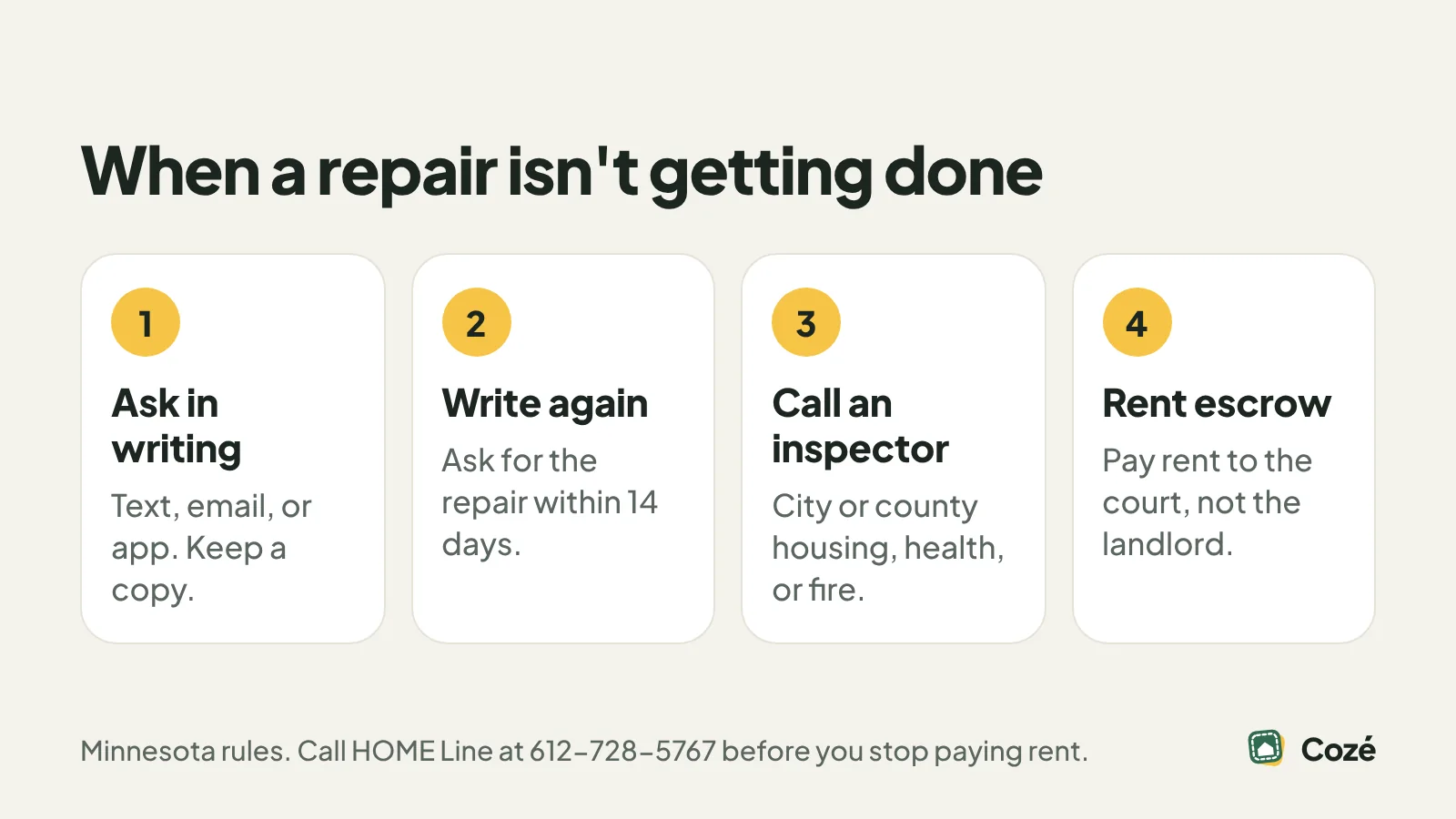
The Attorney General's handbook suggests writing again and asking for the repair within 14 days. You can also ask a local housing, health, or fire inspector to look at the problem. If they find a code violation, the landlord gets a deadline to fix it.
Rent escrow is the formal next step. Instead of paying your landlord, you pay your rent to the court while a judge looks at the problem. For most problems, you have to give the landlord written notice first and wait 14 days. When an inspector has already given the landlord a deadline, you wait for that deadline instead (Minn. Stat. 504B.385). The steps are strict, so read them before you start.
Holding back rent on your own is riskier. The Attorney General's handbook says that if you withhold rent and lose in court, you can owe the rent plus court costs, and the case may show up on tenant screening reports. Before you stop paying anything, call HOME Line, Minnesota's free tenant hotline, at 612-728-5767.
This is general information, not legal advice. Cities can add their own rules, and outside Minnesota the rules are different, so check with your state or a local tenant hotline.
If your landlord uses Havio, you can report a repair from your phone with up to six photos, pick the times that work, and say whether it's OK to come in while you're out. There's a separate button for emergencies, and you'll get an email when a visit is booked.
Sources
- Landlords and Tenants: Rights and Responsibilities, Chapter 2, Minnesota Attorney General. Checked October 27, 2026.
- Minn. Stat. 504B.385, Rent escrow, Minnesota Office of the Revisor of Statutes. Checked October 27, 2026.
- Minn. Stat. 504B.211, Residential tenant's right to privacy, Minnesota Office of the Revisor of Statutes. Checked October 27, 2026.
- Minn. Stat. 504B.381, Emergency tenant remedies action, Minnesota Office of the Revisor of Statutes. Checked October 27, 2026.
- Minn. Stat. 504B.161, subd. 1, Covenants of landlord or licensor, Minnesota Office of the Revisor of Statutes. Checked October 27, 2026.
- When is my landlord required to turn the heat on?, HOME Line. Checked October 27, 2026.
General information, not legal or tax advice. Rules differ by state and city, so check yours or talk to a local professional before acting on it.