Smoke and carbon monoxide alarm rules for Minnesota rentals
Who installs, tests, and replaces smoke and CO alarms in a Minnesota rental, what the statutes say, and a fall walk-through for landlords.
· 4 min read

Say a tenant texts on a Sunday that the hallway smoke alarm has been chirping since Friday, and they finally pulled it off the ceiling to get some sleep. You now have an alarm sitting on a kitchen counter, a tenant who wants it to stop, and a question about whose job it is to fix.
Minnesota answers most of that in two statutes, one for smoke alarms and one for carbon monoxide alarms. They split the work a little differently, so it helps to read them side by side before winter.
What Minnesota requires for smoke alarms
Every dwelling unit in Minnesota must have a smoke alarm that meets the State Fire Code, mounted where the state's rules say, and it has to sound inside that unit when it goes off. In an apartment building, that means every apartment (Minn. Stat. 299F.362, subd. 3 and 4).
When the person living there isn't the owner, the statute puts maintenance on the owner. "The owner is responsible for maintenance of the smoke alarms" (subd. 5). The tenant's job is to tell you when one isn't working, within 24 hours of finding out (subd. 5a). A tenant who willfully disables a smoke alarm, and damage or injury results, commits a misdemeanor (subd. 6).
The statute also lets an owner file inspection and maintenance reports with the local fire marshal as a record that the alarms were checked (subd. 5). Even if you never file one, a dated note of each check is worth keeping with the unit's records.
For where alarms go, the State Fire Marshal's safety tips say to put one in every bedroom, outside each sleeping area, and on every level of the home, basement included. Mount them on the ceiling, or on a wall no more than 12 inches below it.
What Minnesota requires for carbon monoxide alarms
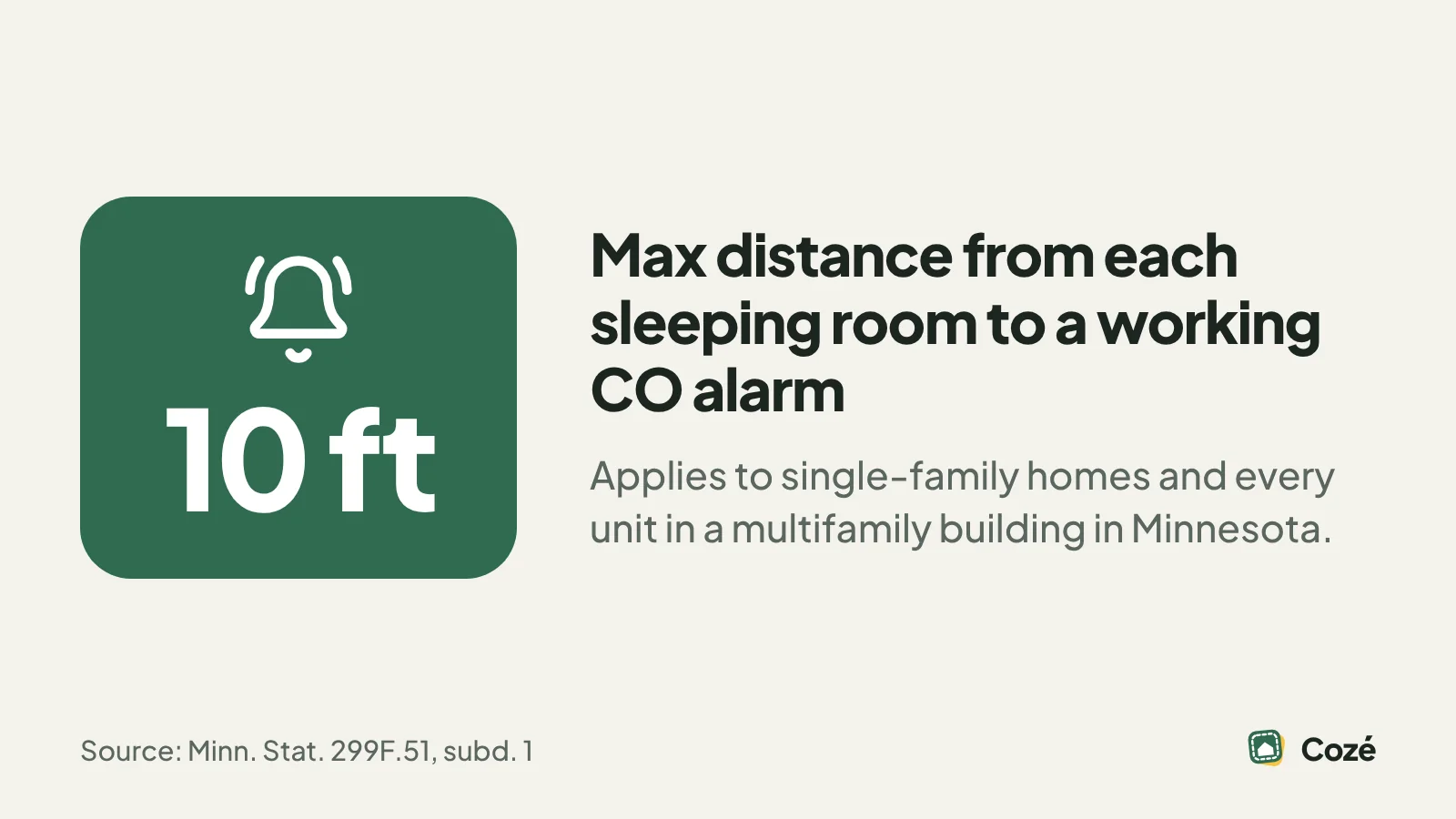
Single-family homes and every unit in a multifamily building must have an approved, working carbon monoxide alarm within 10 feet of each room lawfully used for sleeping (Minn. Stat. 299F.51, subd. 1). The State Fire Marshal's code page says approved alarms are listed to UL 2034, so look for that listing when you buy one.
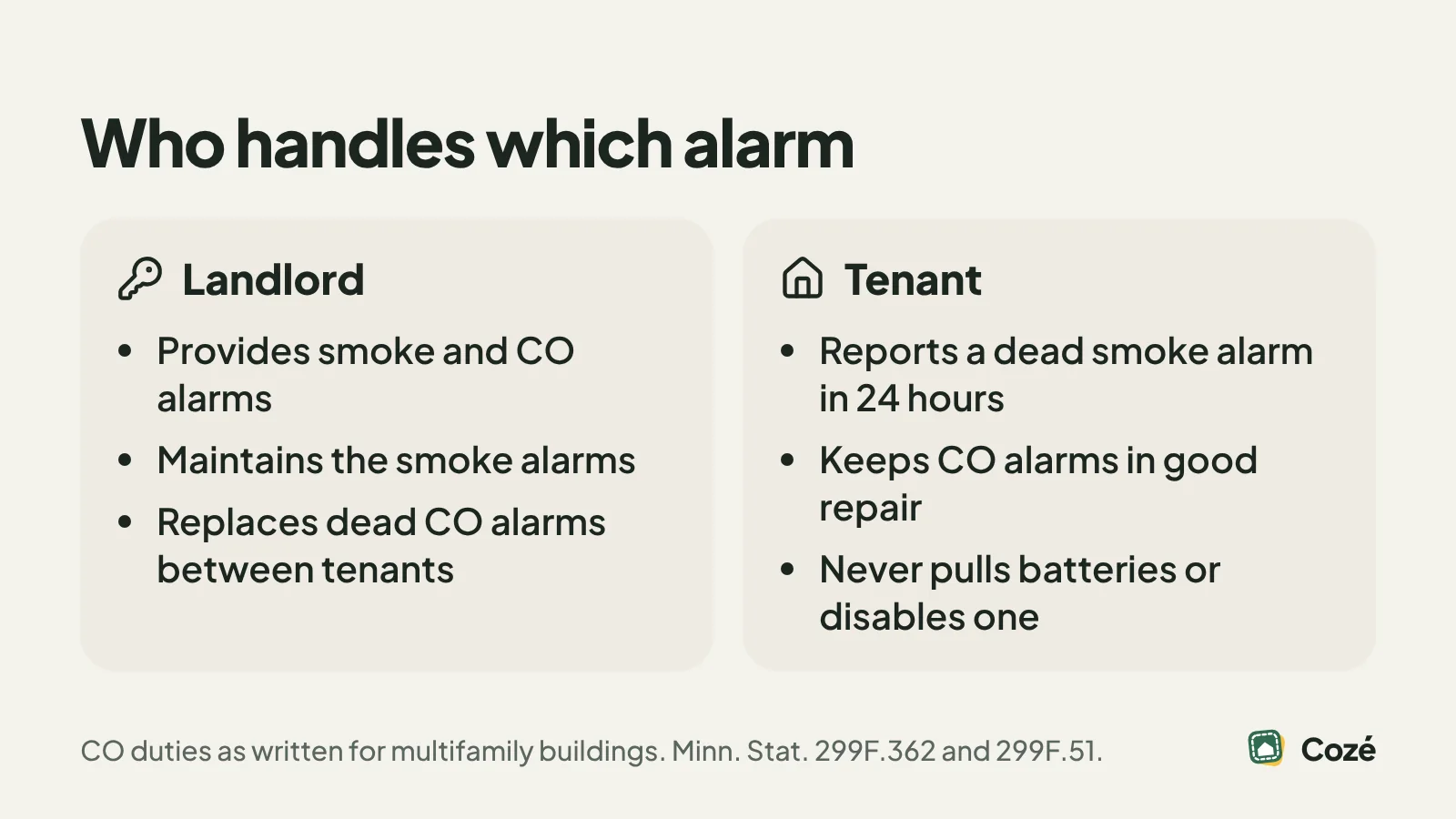
In a multifamily building, the CO statute divides the work this way (subd. 2 and 3).
- The owner provides and installs the alarms.
- The tenant keeps them in good repair while they live there, and replaces one that's stolen, removed, missing, or stops working during their tenancy.
- If a prior tenant left a required alarm missing or dead, the owner replaces it before the next tenant moves in.
Nobody may take the batteries out of a required CO alarm or otherwise make it stop working (subd. 4). A first violation of the CO statute gets a safety warning, and a second or later one is a petty misdemeanor (subd. 6).
That split is written for multifamily buildings. If you rent out a single-family house, the alarm is still required, and it's worth saying in the lease who checks and replaces it.
The fire marshal's code page also describes a narrow exemption for multifamily buildings with minimal or no carbon monoxide sources, where the owner certifies to the commissioner of public safety that there's no foreseeable CO risk (subd. 5). The page lists common sources to think about, including gas or oil furnaces, water heaters, dryers, stoves, fireplaces, and attached parking garages. If you're unsure whether your building qualifies, ask the State Fire Marshal's office before you rely on it.
A fall walk-through for every unit
The two statutes say who's responsible. They don't say how often to test. The State Fire Marshal's tips fill that in. Test smoke and CO alarms monthly, and change batteries once a year (the fall and spring clock changes make easy reminders) unless the alarm has a sealed lithium battery. Hard-wired alarms still need fresh backup batteries.
Alarms also wear out. The same page says to replace smoke alarms every 10 years and CO alarms every five to seven years, and the fire marshal's code page says any device that sounds an end-of-life signal must be replaced. Look for the manufacture date on each alarm so you know how old it is.
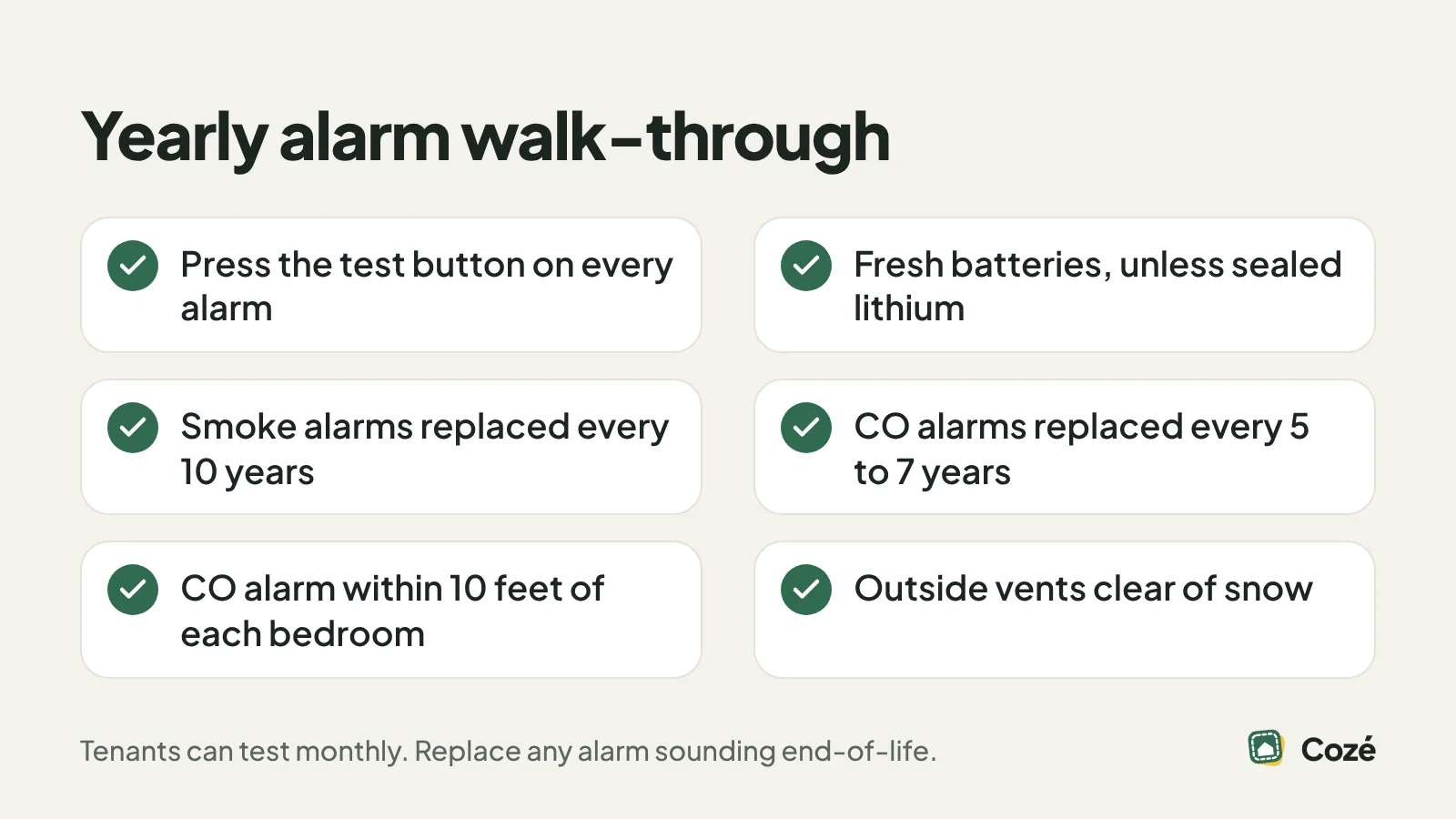
You can't test every alarm every month in a unit someone else lives in. One workable setup is a yearly walk-through by you, with the tenant doing the monthly button test. If you go in yourself, set up a time with the tenant first. A turnover between tenants is another good time, since the CO statute already asks you to replace a missing or dead alarm before the next person moves in.
Before the snow piles up, look at the outside vents too. The State Fire Marshal tells people to keep snow and debris clear of furnace, dryer, fireplace, and oven vents, which is easy to forget once a drift covers them.
When a tenant reports an alarm
If a tenant says a CO alarm is sounding, the State Fire Marshal's advice applies. They leave right away and call 911 from outside. Don't ask them to reset it, take out the battery, or check the furnace first.
A chirp is different. It can mean a low battery or an alarm at the end of its life, and the manual or the label on the back explains which pattern means what. Since you're on the hook for smoke alarm maintenance, plan to go out or send someone soon, even if it's only a battery. An alarm sitting on the kitchen counter protects nobody.
It helps to tell tenants, at move-in and again each fall, how to report a dead or chirping alarm and how fast you'll respond. Minnesota already expects them to tell you within 24 hours for a smoke alarm. If tenants report repairs through Cozé, a chirping alarm can come in with a photo of the label, so you know the model and age before you head out.
The smoke alarm statute also lets cities adopt stricter installation rules for single-family homes (subd. 9). If you're not sure what your city expects, call its rental licensing or fire inspection office.
Sources
- Minn. Stat. 299F.362, Smoke alarm; installation; rules; penalty, Minnesota Office of the Revisor of Statutes. Checked November 2, 2026.
- Minn. Stat. 299F.51, Requirements for carbon monoxide alarms, Minnesota Office of the Revisor of Statutes. Checked November 2, 2026.
- Carbon monoxide detection in residential occupancies, Minnesota State Fire Marshal. Checked November 2, 2026.
- Smoke and carbon monoxide alarm tips, Minnesota State Fire Marshal. Checked November 2, 2026.
General information, not legal or tax advice. Rules differ by state and city, so check yours or talk to a local professional before acting on it.